Oversight-ready answers
Material claims trace to stored sources; thin or missing coverage is explicit—not smoothed over by fluent defaults.
Solutions · Public sector

Illustrative stock photography · Unsplash
Why it matters
Ingest guidance as governed nodes; pair with checkpoints when policy or law changes so “latest” is never ambiguous in a disclosure or incident review. Deploy beside your existing models and identity perimeter—without a full retraining cycle every time guidance updates.
Material claims trace to stored sources; thin or missing coverage is explicit—not smoothed over by fluent defaults.
Checkpoints let you answer “what did we say effective date X?” without rewriting history or losing the thread.
Separate corpora and access boundaries so programs don’t leak context across lines of business or partners.
Use the LLMs you already approve; governed memory is the plane that makes retrieval and provenance legible to reviewers.
Three motions on the memory plane—patterned after how modern solution pages structure value, tuned for agencies: show the evidence, ship answers inside scope, and keep humans accountable.
Surface what your corpus supports—manuals, memos, and program rules—with citations and explicit gaps, not confident filler.
Draft citizen-facing and internal responses from governed memory; escalate when policy is silent, conflicting, or out of date.
Wire reviews and handoffs to the same memory plane so FOIA and audit threads inherit provenance—not one-off chat luck.

Citizen services, policy shops, and digital service teams—one memory plane, scoped per workspace.

Consistent answers from approved program text; when memory is thin, the surface says so—before a case escalates or hits the record.
Versioned directives and interpretations; replay what was in force for a given period or incident.
Copilots that sit inside your identity and data boundaries—governed recall without a separate “shadow” knowledge base.
The same surfaces for ingest, chat, and review—provenance and scope visible to program leads and reviewers.

Deterministic memory—not a black-box retriever.
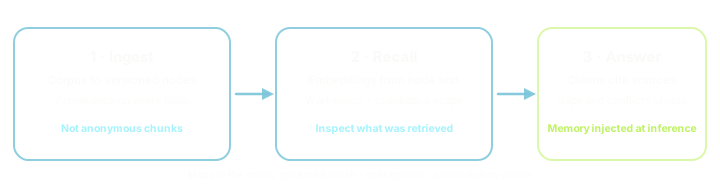
Embeddings from versioned node text; retrieval with a record you can inspect.
Pin knowledge for fiscal years, rulemakings, or incidents—without rewriting history.
Opposing sources stay visible; the UI doesn’t flatten guidance vs. exception into one story.
No product can promise perfect answers in every situation. Amnesis is built so that within the workspace you define, material claims are traceable to stored sources, contradictions stay visible, and “we don’t have that in memory” is a first-class outcome—so teams can stand behind what they ship.