Protocol & policy in memory
Pathways, SOPs, and reference labels as versioned nodes—retrieval you can inspect, not a black-box chunk pile.
Solutions · Healthcare & life sciences

Illustrative stock photography · Unsplash
Why it wins
Amnesis does not replace clinical judgment, institutional review, or compliance programs. It gives every LLM you approve a governed recall layer so assistants and agents stay inside the corpus and checkpoints you define.
Pathways, SOPs, and reference labels as versioned nodes—retrieval you can inspect, not a black-box chunk pile.
Pin “what we knew as of date X” for reviews, submissions, and incidents—without rewriting history.
When the record is silent or conflicting, the surface shows it—instead of smoothing gaps into fluent fiction.
Works with the models and security perimeter you already run; memory is the plane that makes answers defensible.
Three motions teams expect from modern enterprise AI—tuned for care delivery, research ops, and GxP-adjacent workflows: discover what the record supports, stay inside scope, and document what was used.
Surface what your approved corpus supports—guidance, trials readouts, and internal summaries—with citations and explicit gaps.
Scope answers per workspace, role, and checkpoint so copilots inherit the boundaries your policies already require.
Handoffs and reviews inherit provenance—so QA, safety, and audit threads can reconstruct what the AI had permission to say.

Clinical operations, research, and corporate functions—one memory plane, scoped per tenant workspace.

Assistants grounded in pathways and facility policy; escalate when memory is thin or time-bound evidence expired.
Synthesize across approved trials and publications with lineage; contradictions stay visible for human judgment.
HR, quality, and training copilots tied to controlled documents—checkpoints aligned to release cycles.
Hands-on test: ingest → verify in chat → query with context hits visible—so evaluators see memory working, not a scripted demo.

Deterministic memory—not vibes-based retrieval.
Nodes and embeddings tied to preserved text; replay what was retrieved.
Pin knowledge for study locks, policy releases, or incidents.
Opposing sources remain visible; no silent merge into one story.
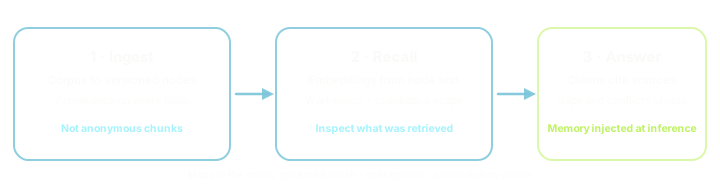
Start with Better RAG: governed ingest, visible retrieval, and an honest “not in memory” path—then expand to Memory OS capabilities as your program matures.