In development
Corporate Decision Outcome Simulator
Stress proposed decisions against governed policy, limits, and historical checkpoints—see where memory supports an outcome and where it does not, before you commit capital or reputation.
Solutions · Financial services

Illustrative stock photography · Unsplash
Roadmap
LLMs without grounding will confabulate; in markets and compliance that is unacceptable. Amnesis scopes answers to what your organization has ingested and versioned, with citations and explicit gaps—so the output is reviewable and defensible, not a confidence act.
In development
Stress proposed decisions against governed policy, limits, and historical checkpoints—see where memory supports an outcome and where it does not, before you commit capital or reputation.
In development
Synthesize filings, research, and internal notes from your corpus only. When evidence is thin, the surface says so—instead of inventing narrative from model priors.
Exploring
Map rule and policy changes to limits, templates, and disclosures with a trail from text to decision support—so “what changed?” is replayable for audit and model risk.
Exploring
Draft from approved disclosures and house language; flag conflicts and missing coverage so human sign-off is about judgment, not guessing what the model read.
Three motions on the memory plane—same pattern teams expect from modern workplace AI pages, tuned for regulated finance: show your work, bound the model, and keep humans in the loop.
Surface what your corpus actually supports—filings, limits, and house research—with citations and explicit “not in memory,” not fluent filler.
Draft memos and recommendations from governed memory; stress proposals against policy and checkpoints before they leave the desk.
Wire reviews and exceptions to the same memory plane so repetitive workflows inherit auditability—not one-off chat luck.

Research, risk, operations, and client-facing teams—one memory plane, scoped per tenant workspace.

Due diligence and narratives tied to ingested filings and internal theses—replayable at a checkpoint.
Limits and methodology memos versioned in time; answer “what did we believe on date X?”
Exceptions and disclosures drawn from approved sources; escalate when memory is thin or conflicting.
The same surfaces your teams use for ingest, chat, and review—designed around provenance and scope.

Deterministic memory—not a black-box retriever.
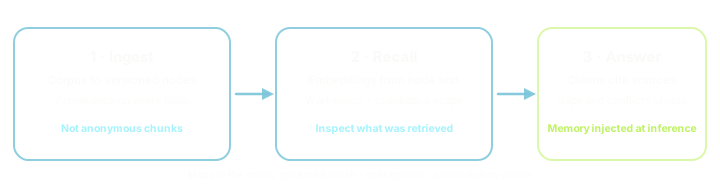
Embeddings from versioned node text; retrieval with a record you can inspect.
Pin knowledge for period-end, incidents, or model-risk review—without rewriting history.
Opposing sources stay visible; the UI doesn’t flatten policy vs. exception into one story.
No product can promise perfect answers in every situation. Amnesis is built so that within the workspace you define, material claims are traceable to stored sources, contradictions stay visible, and “we don’t have that in memory” is a first-class outcome—so teams can stand behind what they ship.